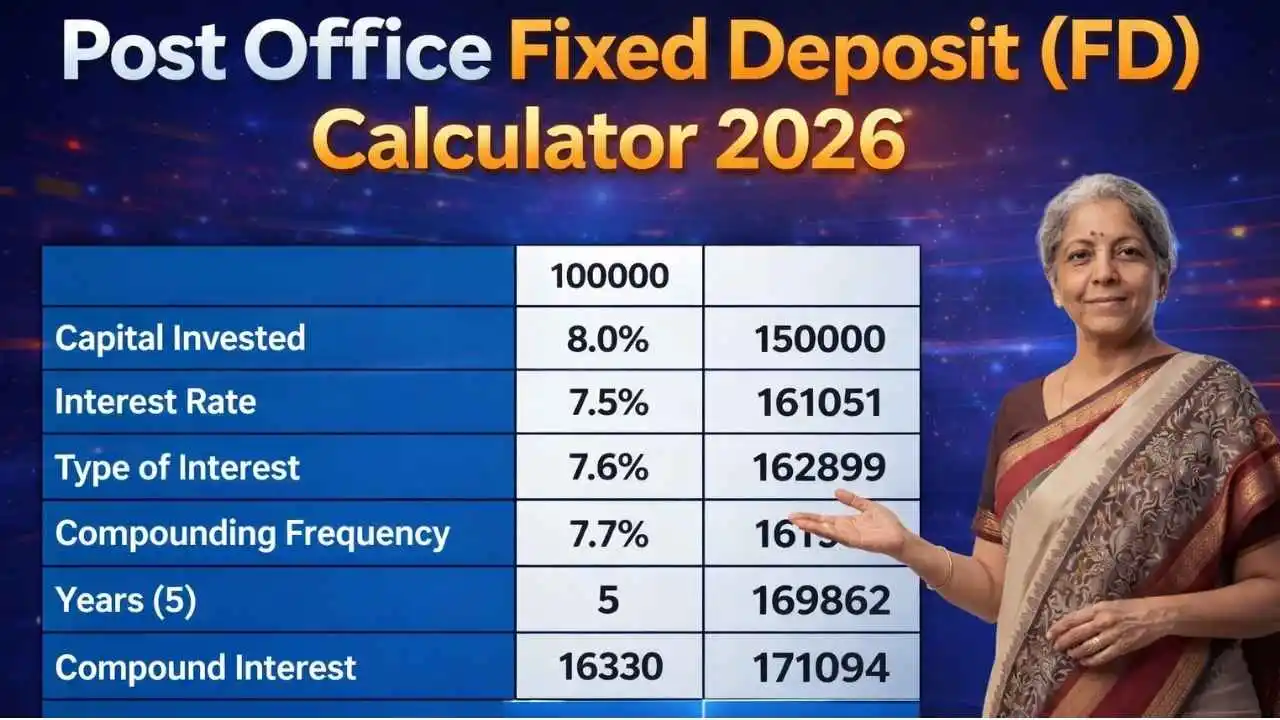
Post Office FD Calculator 2026: In times when financial uncertainty is common, many people look for investment options that offer safety, clarity, and predictable outcomes. The Post Office Fixed Deposit scheme continues to be a trusted choice for individuals who value stability over risk. In 2026, the Post Office FD Calculator has become an essential digital companion, helping savers instantly understand how their money can grow over time.Instead of relying on assumptions or manual calculations, this tool allows anyone—from first-time investors to retirees—to see their maturity value clearly and plan ahead with confidence.
Why Post Office Fixed Deposits Still Matter
Post Office Fixed Deposits are designed for people who want secure growth without exposure to market fluctuations. By investing a lump sum for a fixed period, depositors earn assured returns backed by the Government of India. The structure is straightforward: choose a tenure, lock in your amount, and receive the accumulated value at maturity.This simplicity makes the scheme especially appealing for long-term planners, senior citizens, and families saving for important life goals. The focus is not on quick profits but on preserving capital while earning steady returns.
Post Office Fixed Deposit Scheme 2026: Key Details
| Feature | Information |
|---|---|
| Scheme Name | Post Office Time Deposit (FD) |
| Managed By | Department of Post, Government of India |
| Minimum Deposit | ₹1,000 |
| Maximum Deposit | No upper limit (single account) |
| Available Tenures | 1, 2, 3, and 5 years |
| Interest Calculation | Compounded annually |
| Payout | At maturity |
| Risk Level | Very low (government-backed) |
| Premature Withdrawal | Allowed with conditions |
| Tax Treatment | Interest taxable as per IT rules |
| Suitable For | Risk-averse investors, retirees, long-term savers |
How the FD Calculator Helps in Real Life
The Post Office FD Calculator for 2026 is a user-friendly online tool that converts complex interest calculations into instant results. By entering just the deposit amount and tenure, users can see the estimated maturity value within seconds.This immediate clarity allows people to compare different tenures, adjust investment amounts, and understand how time impacts returns. It turns financial planning into a practical and transparent process, helping users make informed decisions without needing technical knowledge.
Planning Savings Across Different Life Stages
The calculator proves useful at every stage of life. Young earners can use it to plan medium-term goals such as travel or skill development. Parents can estimate how a fixed deposit might support future education expenses. For retirees, it offers a clear picture of stable returns that can support regular expenses or serve as a financial cushion.By connecting numbers to real-life needs, the calculator brings a human touch to financial planning.
Transparency and Control in 2026
Modern investors expect clarity and control over their finances. The FD Calculator meets this expectation by providing accurate projections based on current interest rates. While it does not replace official documentation, it empowers users to approach investments with awareness and realistic expectations.This transparency reduces uncertainty and supports better long-term financial discipline.
Frequently Asked Questions (FAQ)
Q1. Is a Post Office FD a safe investment option?
Yes. It is backed by the Government of India, making it one of the safest fixed-income investments available.
Q2. Can the FD Calculator guarantee the final maturity amount?
The calculator provides an accurate estimate based on current interest rates and selected tenure. The final amount remains the same if the deposit is held till maturity.
Q3. Are joint accounts allowed in Post Office FDs?
Yes. Individuals can open joint accounts with family members under permitted operating rules.
Q4. Can I withdraw my FD before maturity?
Premature withdrawal is allowed after a specified period, but reduced interest may apply as per scheme rules.
Q5. Is the interest earned taxable?
Yes. Interest income from Post Office FDs is taxable according to applicable income tax laws.
Q6. Who should use the Post Office FD Calculator?
Anyone planning a fixed deposit—whether for short-term savings or long-term security—can benefit from using the calculator.
Making Informed Savings Decisions
The Post Office FD Calculator 2026 is more than a digital tool—it is a guide for thoughtful financial planning. By offering instant clarity and reliable projections, it helps individuals align safe investments with personal goals. For those who value security, simplicity, and foresight, this calculator makes planning both easier and smarter.