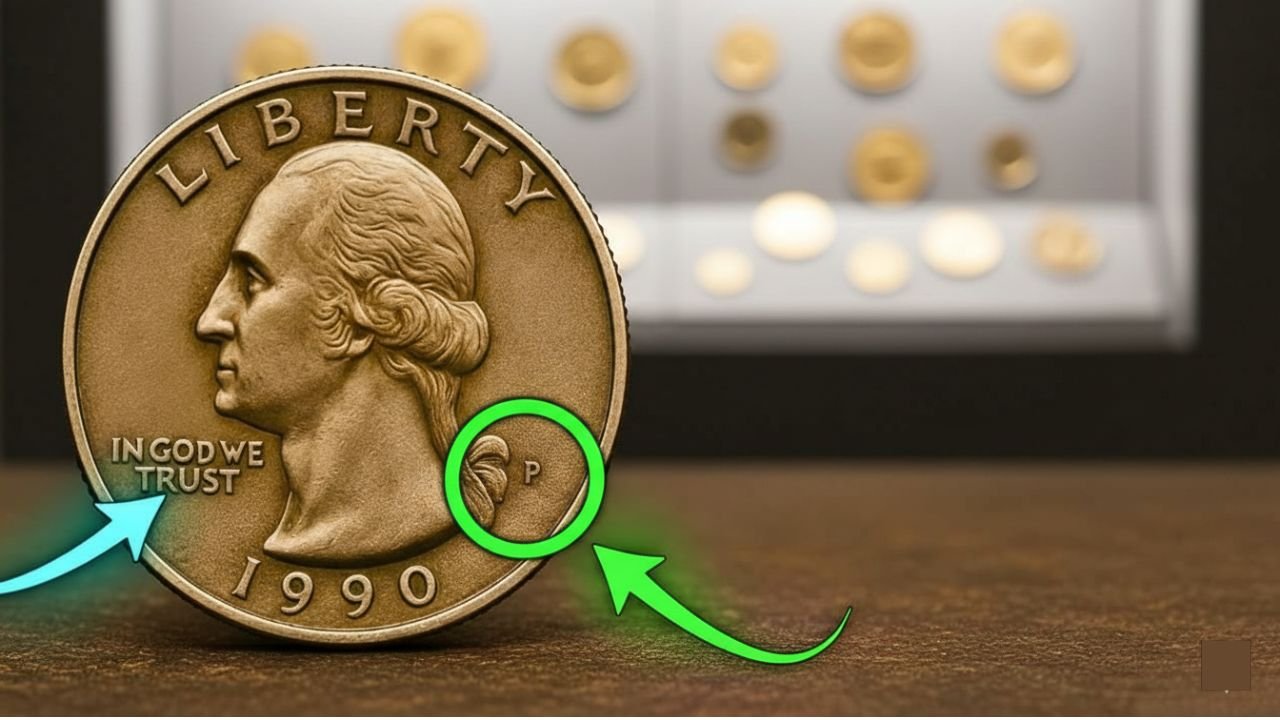
Valuable Washington Quarters : For nearly a century, the Washington Quarter has been a familiar presence in American pockets and purses. First struck in 1932 to commemorate the bicentennial of George Washington’s birth, this coin designed by sculptor John Flanagan transitioned from a commemorative issue to a staple of daily commerce. Beyond its face value, the series holds a captivating secret: certain dates, mint marks, and unusual errors have created rarities that are highly prized in the numismatic world. This guide explores the rich history and value of these coins, offering a clear path for both new and experienced collectors.
Understanding What Makes a Quarter Valuable
A Washington Quarter’s worth is seldom just twenty-five cents. Several key factors converge to transform ordinary change into a collector’s treasure. Rarity, often dictated by low mintage figures, is the primary driver of value. A coin produced in smaller quantities is inherently harder to find. Condition is equally critical; coins that have survived without the wear of circulation in “Mint State” condition can be worth hundreds or thousands of times more than their worn counterparts. Furthermore, minting errors—unintentional quirks in the production process—create unique specimens that captivate collectors. Finally, the historical narrative and collector demand for a specific issue solidify its place in the market and its ultimate price.
Washington Quarter Key Information Table
| Feature | Description |
|---|---|
| Years Minted | 1932 – Present (with composition changes) |
| Original Designer | John Flanagan |
| Original Composition (1932-1964) | 90% Silver, 10% Copper |
| Clad Composition (1965-Present) | Cupro-Nickel layered over a copper core |
| Weight (Silver) | 6.25 grams |
| Weight (Clad) | 5.67 grams |
| Key Mint Marks | S (San Francisco), D (Denver), P (Philadelphia – absent on coins 1965-1979) |
| Notable Rare Dates | 1932-D, 1932-S, 1932 (Philadelphia, low mintage) |
| Popular Error | 2004-D Wisconsin Extra Leaf, 1942-D Doubled Die |
| Highest Grade | MS-70 or PF-70 (Perfect Mint or Proof State) |
Notable Dates and Mint Marks in the Series
Throughout its long run, several Washington Quarters have become legendary for their scarcity and significance. The inaugural year, 1932, features the two undisputed kings of the series. The 1932-D (minted in Denver) and the 1932-S (minted in San Francisco) were produced in limited quantities during the depths of the Great Depression, with mintages of approximately 436,000 and 408,000 respectively. These coins are the cornerstone of any advanced collection. Later years also offer notable issues. The 1942-D Doubled Die Obverse exhibits a distinct doubling of Washington’s portrait and lettering, a clear error cherished by specialists. The 1950-D/S Overmintmark shows a “D” mint mark punched over an “S,” telling a story of corrected dies sent between mints. Even modern quarters can be valuable, as seen with the 2004-D Wisconsin Extra Leaf Quarter, where an extra leaf appears on the cornstalk on the state reverse, creating a popular error variant.
The Captivating World of Minting Errors
Error coins represent some of the most thrilling finds in numismatics. These mistakes occur during the striking process and result in coins that deviate from the standard design. Common types include doubled dies (where the design elements appear duplicated), off-center strikes (where the coin image is misaligned), and wrong planchet errors (where a coin is struck on a blank meant for another denomination). Because such coins are usually caught by quality control and destroyed, those that escape into circulation are rare novelties that command significant premiums due to their uniqueness and the story they tell about the minting process.
The Critical Role of Grading and Preservation
A coin’s condition is objectively assessed through a process called grading. Professional services grade coins on the Sheldon Scale, from 1 (Poor) to 70 (Perfect Mint State). The difference between a grade of MS-60 and MS-67 can mean a difference of thousands of dollars for a key date. Grading provides authentication, verifies condition, and offers a standardized language for buyers and sellers. For collectors, understanding grading is essential, as a coin’s eye appeal and state of preservation are directly tied to its market value and investment potential.
Building a Collection Hobby and Investment
Collecting Washington Quarters can be a deeply rewarding pursuit, blending historical education with the thrill of the hunt. A complete set is a challenging but achievable goal, often pursued by date and mint mark. From a financial perspective, rare coins have historically served as a tangible asset that can appreciate over time and diversify an investment portfolio. While not without market fluctuations, high-quality, rare coins have shown resilience, often acting as a store of value independent of traditional stocks and bonds.
How to Begin Your Search
You don’t need to be an expert to start looking for valuable quarters. Begin by examining your own change, focusing on dates before 1965 (which are struck in 90% silver). Use a simple magnifying glass to check for mint marks (found on the reverse below the wreath) and to inspect for obvious doubling or irregularities. Invest in a reputable coin guidebook or use trusted online resources to familiarize yourself with key dates and error types. Handle coins carefully by the edges to preserve their condition, and consider joining a local coin club or online forum to learn from experienced collectors.
Frequently Asked Questions (FAQ)
Q: Are all Washington Quarters made of silver?
A: No. Only quarters dated 1964 and earlier are composed of 90% silver. Those dated 1965 to the present are made from a copper-nickel clad composition. Special proof and silver sets for collectors sometimes contain modern silver quarters.
Q: What is the most valuable Washington Quarter?
A: The 1932-D and 1932-S quarters in top Mint State grades (MS-66 or higher) are the most valuable regular-issue coins, regularly selling for tens of thousands of dollars. High-grade error coins can also reach similar price levels.
Q: Where is the mint mark on a Washington Quarter?
A: For most of the series, the mint mark is located on the reverse (tails) side, just below the center point where the wreath is tied. On Bicentennial (1976) and early 50 States quarters, it is found on the obverse, to the right of Washington’s hair.
Q: How can I get my coins professionally graded?
A: You can submit coins directly to third-party grading services like PCGS (Professional Coin Grading Service) or NGC (Numismatic Guaranty Company). They charge a fee based on the coin’s value and service level, encapsulating it in a protective, tamper-evident holder with the grade displayed.
Q: Is it worth collecting modern quarters?
A: Absolutely. While most modern quarters are common, collecting them can be an educational and affordable starting point. Focus on searching for error coins or building complete sets of series like the 50 States or America the Beautiful quarters in pristine, uncirculated condition, which may hold future value.
The journey through the world of Washington Quarters is a journey through American history itself, marked by artistry, industry, and occasional delightful mistakes. Whether you’re drawn by the allure of silver, the hunt for a rare date, or the simple pleasure of preserving history, this enduring series offers a rewarding and accessible entry point into the fascinating hobby of coin collection.
