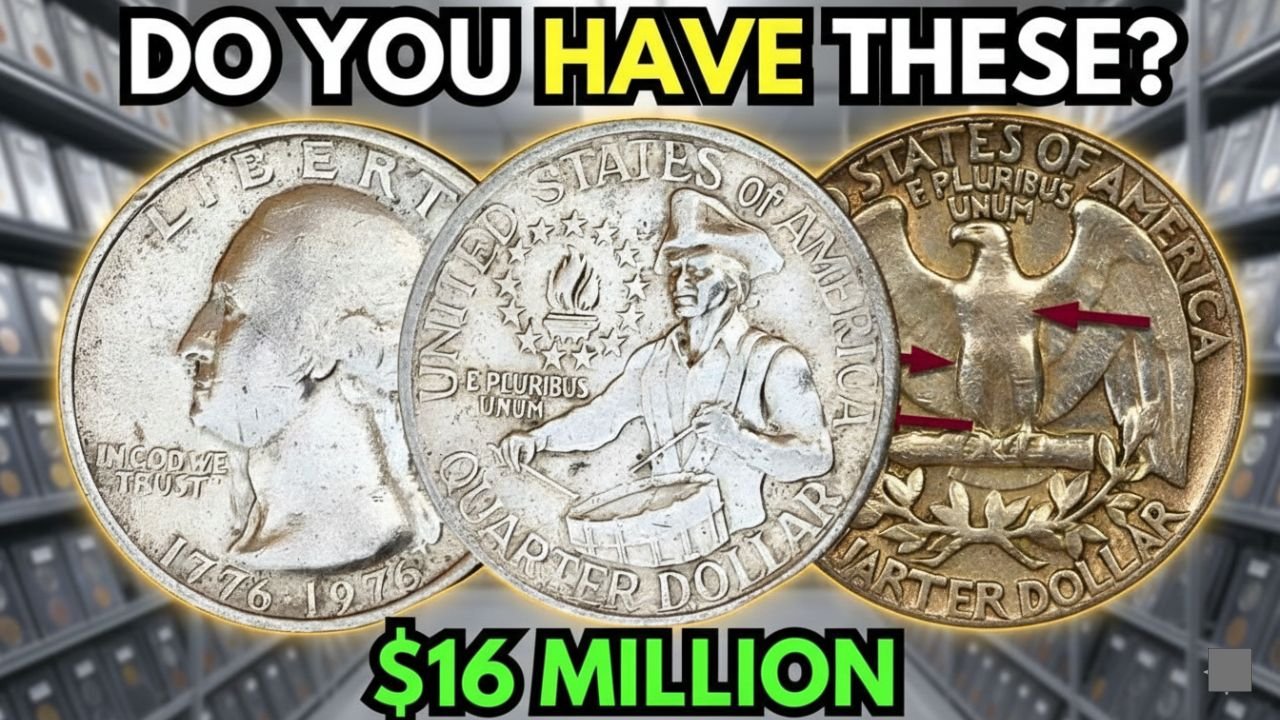
2026 Bicentennial Quarter Value : The simple act of checking your pocket change can sometimes feel like a mini archaeological dig, a sifting through recent history. Few modern U.S. coins embody that history as distinctly as the 1976 Bicentennial Quarter. Released to celebrate the nation’s 200th birthday, this familiar coin holds a special place in the hearts of collectors and history enthusiasts alike. While sensational stories of multi-million dollar valuations are the realm of myth, a genuine understanding of this quarter reveals a far more accessible and fascinating narrative about numismatics, heritage, and the thrill of the hunt.
A Coin Forged in Celebration
The year 1976 marked a monumental anniversary for the United States: two centuries of independence. To commemorate this event, the U.S. Mint embarked on a special program, redesigning the quarter, half dollar, and dollar coins for the bicentennial. For the quarter, the familiar eagle on the reverse (tails) side was temporarily retired. In its place, a powerful image of a colonial drummer, with a victory torch encircled by thirteen stars, was introduced. This design, by Jack L. Ahr, symbolized the spirit of 1776. The obverse (heads) retained John Flanagan’s profile of George Washington but was notable for its dual date “1776-1976.” This special design appeared on quarters minted in 1975 and 1976, with all coins bearing the 1976 date.
Understanding What Drives Value
The vast majority of the billions of Bicentennial Quarters minted are worth exactly their face value: 25 cents. Their abundance in circulation is a testament to the scale of the celebration. However, specific factors can elevate a standard quarter into a collectible item. Value is primarily determined by three elements: composition, condition, and striking errors. Standard circulation quarters were struck in a copper-nickel clad composition. However, the Mint also produced 40% silver versions specifically for collectors. These were not released into general circulation and were sold in special three-coin sets or as individual proof and uncirculated specimens. These silver issues are inherently more valuable due to their precious metal content and limited availability. Condition is paramount. A quarter that has been worn smooth from decades of use holds little premium. Conversely, a coin that has been preserved in “Mint State” or “Proof” condition—with sharp details, original luster, and no signs of wear—can be worth significantly more to a collector. Finally, minting errors, though exceptionally rare, can create unique and valuable coins. Examples include double strikes, off-center designs, or missing clad layers. These “mistakes” are highly sought after by specialists.
A Practical Guide for Identification
For anyone curious about the coins in their possession, here is a straightforward guide to identifying potential keepsakes:
- Check the Edge: The quickest test. A standard copper-nickel quarter will have a distinct copper-brown stripe sandwiched between silver-colored layers on its edge. A 40% silver Bicentennial Quarter will have a solid silver-gray edge with no copper stripe.
- Look for the Mint Mark: Find the small letter on the obverse, just to the right of Washington’s ribbon. A “D” (Denver) or no mint mark (Philadelphia) indicates a common circulation strike. An “S” (San Francisco) mint mark typically denotes a proof or silver proof coin, which was sold directly to collectors.
- Assess Condition: Examine the drummer’s arm and torch for fine details. If the high points are worn flat, it’s a circulated coin. If it retains sharp, frosty, or mirror-like surfaces with no abrasions, it may be uncirculated or proof.
- Look for Errors: Under good light, check for any doubling in the lettering or date, or if the design is struck off-center. These require careful comparison to a normal coin.
The Enduring Allure of the Hunt
Beyond potential value, the Bicentennial Quarter represents a tangible connection to a national milestone. It serves as an entry point into the hobby of coin collecting, a pursuit that blends history, art, and detective work. The notion that a rare piece could still be discovered in an old jar or estate sale fuels excitement and encourages a closer look at the everyday objects we often overlook. It’s a reminder that history is not just in textbooks—it’s in our hands.
1976 Bicentennial Quarter Key Information Table
| Feature | Details |
|---|---|
| Year(s) Minted | 1975 & 1976 (All bear the dual date 1776-1976) |
| Obverse Designer | John Flanagan (Modified from original 1932 design) |
| Reverse Designer | Jack L. Ahr |
| Standard Composition | Copper-Nickel Clad (Outer layers: 75% Cu, 25% Ni; Core: 100% Cu) |
| Special Composition | 40% Silver (Outer layers: 80% Ag, 20% Cu; Core: 20% Ag, 80% Cu) |
| Mint Marks | P (Philadelphia, none on quarter), D (Denver), S (San Francisco) |
| Circulation Mintage | Approximately 1.6 Billion (combined from Philly & Denver) |
| Collector Versions | Proof (S Mint, mirror finish), Uncirculated Sets (S & P Mints), 40% Silver Sets |
| Face Value | $0.25 (25 cents) |
| Modern Circulation Value | $0.25 for worn, copper-nickel coins |
Frequently Asked Questions (FAQ)
Q: Is my 1976 Bicentennial Quarter worth millions of dollars?
A: No. Stories of Bicentennial Quarters being valued in the millions are fictional and not based on numismatic reality. While rare error coins or exceptional specimens can be worth thousands, no known Bicentennial Quarter has ever sold for anywhere near a million dollars.
Q: How can I tell if my Bicentennial Quarter is silver?
A: The simplest test is to examine the edge of the coin. A standard quarter has a visible brown copper stripe. A 40% silver Bicentennial Quarter will have a solid silver-colored edge with no copper band.
Q: What is the most valuable type of Bicentennial Quarter?
A: The most valuable are typically those in top-graded condition (like MS-67 or higher by PCGS or NGC) or rare mint error specimens (e.g., dramatic double strikes, off-center strikes). High-grade 40% silver proof examples from the San Francisco Mint also hold significant value.
Q: I found a Bicentennial Quarter with an “S” mint mark. Is it rare?
A: It is less common than those from Denver or Philadelphia, as “S” mint coins were not intended for general circulation. They were sold directly to collectors in proof or uncirculated sets. In pristine, original condition, they have collectible value. A worn “S” mint quarter likely spent decades in circulation after being spent from a collection.
Q: Where is the best place to get my coin professionally evaluated?
A: For a serious evaluation and authentication, consider submitting your coin to a leading third-party grading service such as the Professional Coin Grading Service (PCGS) or the Numismatic Guaranty Company (NGC). For casual advice, a reputable local coin dealer can provide an initial assessment.
Q: Why do people still search for these coins if they are so common?
A: The search is driven by the joy of collecting, the hope of finding a rare error or superb condition coin, and the connection to American history. It’s a hobby that encourages learning and offers the genuine, if slim, possibility of a valuable discovery.
